Disabled Facilities Grant Guide | Bathroom Funding & VAT Relief
Published: 15 November 2018 · Last Updated: 10 August 2026
an You Get a Grant for an Accessible Bathroom?
Adapting your bathroom can make a significant difference to your safety, comfort and independence. Whether you're finding it difficult to step into the bath, need easier access to a shower or require specialist equipment to support your mobility, making the right adaptations can help you remain independent in your own home for longer.
For many people, however, the biggest question isn't what changes are needed—it's how they'll pay for them.
The good news is that financial support may be available. Depending on your circumstances, you could be eligible for a Disabled Facilities Grant (DFG), VAT relief or other forms of assistance to help reduce the cost of your bathroom adaptation.
In this article, we'll explain the different types of financial support that may be available, including Disabled Facilities Grants, VAT relief and other funding options. We'll also cover who may be eligible, what support can help cover and where to find further information.
What Is a Disabled Facilities Grant?
A Disabled Facilities Grant (DFG) is a local authority grant designed to help disabled people make essential adaptations to their homes so they can live more safely and independently.
The funding is intended for adaptations that are considered necessary and appropriate to meet the needs of the disabled person, helping them access and use key areas of their home more easily.
Bathroom adaptations are among the most common improvements funded through a Disabled Facilities Grant and may include replacing a traditional bath with a level access shower, installing a walk-in bath or creating a fully disabled wet room.
In England, a Disabled Facilities Grant can provide funding of up to £30,000, although some local authorities may provide additional discretionary funding where circumstances justify it.
The grant is administered by your local council, who will assess both your eligibility and the adaptations recommended for your home before approving any funding.
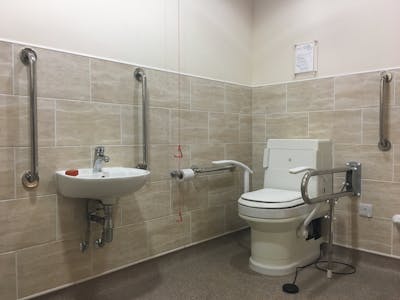
Alt: Mobility wet room with shower seat, toilet and pedestal basin
What Bathroom Adaptations Can a Disabled Facilities Grant Help Pay For?
A Disabled Facilities Grant can help fund a wide range of bathroom adaptations where they are considered necessary to meet the needs of the disabled person. The specific adaptations approved will depend on your individual circumstances and the recommendations made during your assessment.
Depending on your needs, funding may contribute towards:
The purpose of these adaptations is to help you use your bathroom more safely, comfortably and independently, rather than simply improving its appearance.
Before funding is approved, your local authority will normally arrange for an Occupational Therapist to assess your needs. Their recommendations help determine which adaptations are considered necessary and appropriate for your home.

Who Can Apply for a Disabled Facilities Grant?
You may be able to apply for a Disabled Facilities Grant if you, or someone living in your home, has a disability or long-term health condition that makes essential adaptations necessary to improve safety, accessibility or independence.
Applications can typically be made by:
- Homeowners.
- Private tenants.
- Housing association tenants.
- Some landlords applying on behalf of tenants.
- Parents or guardians of disabled children.
The definition of disability is broader than many people realise. It isn't limited to wheelchair users and doesn't require someone to be registered disabled.
People living with conditions such as arthritis, multiple sclerosis, Parkinson's disease, the effects of a stroke, neurological conditions or reduced mobility may be eligible where those conditions significantly affect everyday activities and the way they use their home.
Each application is assessed individually by the local authority, considering both the applicant's circumstances and whether the proposed adaptations are considered necessary and appropriate.
Is a Disabled Facilities Grant Means Tested?
Whether a Disabled Facilities Grant is means tested depends on who the application is for.
For most adult applicants, the grant is means tested. This means your local authority will assess your financial circumstances, including factors such as income and savings, to determine whether you're required to contribute towards the cost of the adaptations.
Different rules apply in some circumstances. For example, applications made on behalf of disabled children under the age of 18 are not normally subject to a means test, meaning household income and savings are generally not considered.
Your local authority will explain the financial information required as part of your application and advise whether you're eligible for full or partial funding.
How Do You Apply for a Disabled Facilities Grant?
Although the process varies slightly between local authorities, applying for a Disabled Facilities Grant generally begins by contacting your local council to request an assessment.
In most cases, the process will involve:
- Contacting your local authority to discuss your requirements.
- An assessment by an Occupational Therapist (OT) to determine what adaptations are necessary.
- A home assessment to identify the most appropriate adaptations for your property.
- Submitting a Disabled Facilities Grant application and any supporting information requested by the local authority.
- A financial assessment, where applicable.
- Approval of the grant and the proposed adaptations.
- The local authority obtaining quotations or inviting approved contractors to tender for the work, in accordance with its procurement process.
- The local authority appointing the successful contractor to carry out the approved adaptations.
- Installation of the approved adaptations.
It's important not to begin any work before receiving formal grant approval, as starting your project early could affect your eligibility for funding.
The exact process will vary between local authorities. Some councils operate approved contractor frameworks or tender processes, meaning the contractor carrying out the work is selected by the council rather than the homeowner.
How Long Does the Disabled Facilities Grant Process Take?
One of the most important things to understand about a Disabled Facilities Grant is that the application process can take time.
Timescales vary between local authorities and depend on several factors, including the demand for Occupational Therapist assessments, the complexity of your requirements and the number of applications being processed.
A typical application may involve:
- Waiting for an Occupational Therapist assessment.
- Preparing recommendations and supporting documentation.
- Completing the grant application.
- A financial assessment, where applicable.
- Approval by the local authority.
- The local authority obtaining quotations or inviting approved contractors to tender for the work.
- Appointment of the successful contractor.
- Scheduling and completing the installation.
Some applications progress within a few months, while others can take considerably longer, and in some instances years.
If your needs are urgent, it's important to explain this to your local authority as early as possible. Some councils may prioritise applications where there is an immediate risk to a person's health, safety or ability to live independently, although this will depend on local policies and available resources.
If you're considering a bathroom adaptation, it's often worthwhile exploring all of the available options. While some people choose to wait for grant funding, others decide to fund their project privately so work can begin sooner.
Can You Choose Your Own Bathroom Company?
This depends on how your local authority administers its Disabled Facilities Grant programme.
In many cases, local authorities appoint contractors through approved contractor frameworks or competitive tender processes. Once your grant has been approved, the council will typically invite approved contractors to submit quotations before selecting the company that will carry out the work.
Some local authorities may allow applicants to obtain quotations from a specialist bathroom company of their choice, although this will depend on the council's procurement procedures and should always be discussed with your case officer before obtaining quotations.
If you're funding your bathroom adaptation privately, you'll have complete control over your project. You'll have the freedom to choose the company you work with, tailor the layout and specification to your individual needs, select the products and finishes you prefer, and often benefit from a much quicker route to installation.

Can You Apply if You Own Your Home?
Yes. Owning your home does not prevent you from applying for a Disabled Facilities Grant.
Homeowners are among the most common applicants, although the grant may also be available to private tenants, housing association tenants and, in certain circumstances, landlords applying on behalf of disabled tenants.
The key consideration is not the type of property you live in, but whether the proposed adaptations are considered necessary and appropriate to meet the needs of the disabled person.
What if You Don't Qualify for a Disabled Facilities Grant?
Not everyone will meet the eligibility criteria for a Disabled Facilities Grant, and some people choose not to wait for the application process to be completed.
If grant funding isn't available, there are still several ways to make your bathroom safer and more accessible.
Many homeowners choose to fund their bathroom adaptation privately, allowing work to begin sooner while providing complete flexibility over the products, layout and overall design.
Depending on your circumstances, you may also wish to explore:
- Local authority discretionary assistance schemes.
- Charitable grants.
- Support available through veterans' organisations.
- Assistance from condition-specific charities.
- Home improvement agencies operating within your area.
If you're considering a privately funded bathroom adaptation, our experienced team can help you understand the likely investment required and design a solution tailored to your individual needs.
Disabled Facilities Grants and VAT Relief – What's the Difference?
Disabled Facilities Grants and VAT relief are often confused, but they are two entirely separate forms of financial support.
A Disabled Facilities Grant (DFG) is funding provided by your local authority to help pay for essential adaptations that enable a disabled person to live more safely and independently.
VAT relief, on the other hand, is a reduction in the amount of VAT charged on qualifying products and installation work where specific HMRC conditions are met.
In some circumstances, a bathroom adaptation may benefit from both. While the Disabled Facilities Grant and VAT relief are assessed independently, qualifying projects may be eligible for grant funding alongside VAT relief on certain products and installation work.
Understanding whether your project qualifies for VAT relief could make a significant difference to the overall cost of your bathroom adaptation. If you're planning an accessible bathroom, our experienced team can explain the eligibility requirements, answer any questions you may have and ensure any qualifying VAT relief is clearly reflected within your quotation.
To learn more about VAT relief, visit out Disabled Bathroom Prices & VAT Relief page.
More Than Just Funding
At More Ability, we understand that adapting your bathroom is about far more than grants or financial support.
It's about creating a space that helps you bathe safely, maintain your independence and enjoy greater confidence within your own home.
From your initial home design appointment through to the completed installation, we'll take the time to understand your needs, recommend practical solutions and design a bathroom tailored to your lifestyle, mobility requirements and future needs.
As specialists in accessible bathroom design and installation, we're familiar with the grants, funding options and VAT relief that may be available to some customers. While we don't arrange grant funding or provide financial advice, we can explain how VAT relief applies to our projects and help you understand the funding routes that may be available before you begin your renovation.
Every bathroom is individually designed, professionally installed and fully managed by one experienced team, giving you a single point of contact from your initial consultation through to completion and aftercare.

Planning a Private Bathroom Adaptation?
More Ability specialises in privately funded accessible bathroom adaptations, designed and installed for homeowners across Yorkshire.
Choosing to fund your project privately gives you complete control over your renovation. You'll have the freedom to choose the layout, products, finishes and overall specification that best suit your needs, without being restricted to an approved scheme or standard specification. It also allows your project to progress more quickly, with greater flexibility over design decisions and installation timescales.
Every bathroom is individually designed around your lifestyle, mobility requirements and personal preferences, creating a space that's practical, comfortable and beautifully finished. Where applicable, we'll also explain whether your project qualifies for VAT relief and ensure any eligible savings are clearly reflected within your quotation.
Why Choose More Ability?
Choosing the right company to design and install your accessible bathroom is one of the most important decisions you'll make.
Backed by more than 60 years of bathroom renovation experience across Yorkshire, More Ability specialises in designing and installing accessible bathrooms that improve safety, comfort and independence without compromising on style or quality.
Unlike many accessible bathroom providers, we believe practical solutions should enhance your home rather than feel clinical or institutional. Every bathroom is individually designed around your needs, combining thoughtful accessibility with attractive, contemporary design and quality craftsmanship.
When you choose More Ability, you'll benefit from:
- Over 60 years of bathroom renovation expertise across Yorkshire.
- Specialists in accessible bathroom design and installation.
- Free home design appointments throughout Yorkshire.
- Advice on VAT relief eligibility for qualifying projects.
- Fully managed design, supply and installation service.
- Qualified employed installers and experienced specialist trades.
- Dedicated project management from start to finish.
- Comprehensive guarantees for complete peace of mind.
Whether you're replacing a bath with an accessible walk-in shower, creating a disabled wet room or planning a more bespoke bathroom adaptation, we'll help you create a solution that's designed around your needs today and for years to come.
Start Planning Your Accessible Bathroom
Whether you're ready to begin your privately funded bathroom adaptation or are simply exploring the options available, our experienced team is here to help.
We'll take the time to understand your lifestyle, mobility requirements and long-term needs before designing an accessible bathroom that's practical, comfortable and tailored to your home.
To begin your project, Book a Free Home Design Appointment or Visit one of our Yorkshire Showrooms to discover how More Ability can create a beautifully designed accessible bathroom that's tailored to your needs.

Frequently Asked Questions
Can I apply for a Disabled Facilities Grant myself?
Yes. Applications are normally made directly through your local authority. If you're unsure where to begin, your council's Adult Social Care or Housing department will usually be able to advise you.
How much funding can I receive?
In England, a Disabled Facilities Grant can provide funding of up to £30,000, although some local authorities may offer additional discretionary assistance depending on individual circumstances.
Do I have to repay a Disabled Facilities Grant?
In many cases, no. However, some local authorities may place conditions on larger grants, particularly if you sell your property within a specified period. Your council will explain any conditions before the grant is approved.
Can I choose the style of my new bathroom?
Yes. While the adaptations funded through the grant will need to meet your assessed needs, many customers choose finishes, colours and products that reflect their personal taste. If you wish to include upgrades beyond the approved scheme, you may be able to contribute towards the additional cost yourself.
Will my bathroom look clinical?
Not at all.
Modern accessible bathrooms combine practical accessibility with contemporary design, allowing you to create a bathroom that is both beautiful and easy to use.
Many accessibility products are now available in a wide choice of colours, finishes and styles, making it possible to achieve a bathroom that complements the rest of your home.
Share this Post


.jpg?auto=compress%2Cformat&cs=strip&fit=clip&h=400&ixlib=php-1.1.0&w=400&s=9fa3862dd64550f902ce5099d00692fb)